

Greece offers travelers a multidimensional and unforgettable cultural experience, combining a glorious past that laid the foundations for the modern world with a vibrant, warm, and unique present. Scattered across its mainland and thousands of islands are historical monuments, world-class museums, colorful festivals, and a tradition of hospitality that is second to none. This is a region that invites visitors to dive into the culture that has influenced the thought, art, and life of the entire world.
History, Philosophy, and the Cradle of Democracy
Ancient Greece is not just a collection of impressive antiquities or photogenic ruins scattered across the landscape; it is, in fact, the cradle of Western civilization and the living source of many concepts that shape human society and modern thought to this day.
Through the silent stones of its temples and amphitheaters echoes the intellectual legacy that laid the groundwork for our world: in the open Agora of Athens, the seeds of democracy, freedom of speech, politics, and civil rights were sown. Under the Mediterranean sky grew the philosophy of intellectual giants such as Socrates, Plato, and Aristotle, who taught humanity to ask questions, explore morality, and seek truth through reason and logic. Meanwhile, scientists, physicians, and mathematicians like Pythagoras, Archimedes, and Hippocrates broke new ground in understanding the laws of nature and the human body.
The Greek contribution did not stop there—it invented theater with its tragedies and comedies, defined the ideals of beauty, symmetry, and proportion in art and architecture, and bestowed upon us the spirit of excellence and sportsmanship through the Olympic Games. Therefore, observing the remnants of Ancient Greece is much more than a historical tour; it is a fascinating journey into the deepest roots of our modern thought, law, science, and culture.
- The Invention of Democracy and Politics: The concept of democracy developed in Athens around the 6th century BC. The Greek word “Demokratia” is composed of “Demos” (people) and “Kratos” (power/rule). This is where ideas such as citizenship, freedom of speech, and popular assemblies were born.
- The Birth of Philosophy and Science: Greece was home to intellectual giants like Socrates, Plato, and Aristotle, who laid the foundation for Western philosophy. Alongside them, scientists and mathematicians like Pythagoras and Archimedes made discoveries that we still use today.
- Theater and Literature: Greek culture invented theater (tragedy and comedy) from the rituals of the god Dionysus. It is deeply intertwined with mythological tales of the Olympian gods, immortalized in timeless masterpieces like Homer’s “Iliad” and “Odyssey.”
Archaeological Sites: A Testament to Empires of the Past
The UNESCO World Heritage sites, scattered across the length and breadth of the mainland and islands, are a must-see for anyone seeking a deeper understanding of the roots of Western civilization, as they function as an open history book carved in stone. These sites are not merely silent remnants of the past, but living landmarks that vividly and powerfully unfold the story of the rich and turbulent eras the country has experienced, from the dawn of humanity to the formation of modern Greece.
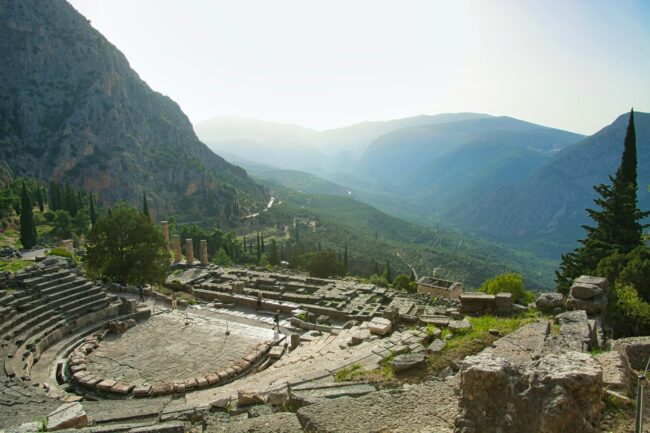
A journey through them takes visitors into the depths of time: starting from the mysterious remains of the Mycenaean and Minoan civilizations, through the architectural, philosophical, and artistic splendor of the Classical period—visible through the columns of the Parthenon at the Acropolis, the perfect acoustics of the theater in Epidaurus, and the mysticism of the Oracle at Delphi.
From there, the historical narrative continues to the spiritual power of the Byzantine Empire, evident in the marvelous suspended monasteries of Meteora or the ghost town of Mystras, and on to the Middle Ages and foreign rule that left their mark on the knight’s castles of the old city in Rhodes or the Venetian architecture of Corfu. Each of these sites essentially serves as a unique time capsule blending into the natural landscape, illustrating how layer upon layer of history, mythology, and conquests merged together to shape the complex and captivating Greek identity we encounter today.
- The Acropolis of Athens: A hilltop citadel housing the most iconic monuments of Ancient Greece, most notably the Parthenon—the temple dedicated to the goddess Athena, which has become the eternal symbol of architectural perfection.
- Delphi: Considered in ancient times to be the “navel of the world.” It was the seat of the Oracle of Delphi, a pilgrimage site for kings and generals seeking prophecies.
- Palaces of the Minoan and Mycenaean Civilizations: Knossos in Crete, home to ruins from the ancient and advanced Minoan civilization, and Mycenae in the Peloponnese, the city of the heroes of the Trojan War.
- Ancient Olympia: The sacred site where the Olympic Games were born in 776 BC.
Museums, Art, and Leisure
Greece is home to countless cultural institutions, galleries, and museums, which serve as much more than exhibition spaces; they act as living gateways for a journey through time, showcasing the continuous and fascinating evolution of art from antiquity, through the days of the Byzantine Empire, and up to the present day.
The journey begins in the impressive halls of institutions like the Acropolis Museum and the National Archaeological Museum, where visitors can marvel at the aesthetic perfection of classical sculpture, ancient gold jewelry, and decorated pottery that bring the myths of the past back to life.
From there, the historical continuum takes the visitor into an era of deep spirituality in the Byzantine museums (such as the Byzantine and Christian Museum in Athens), illuminated by a precious glow and featuring magnificent mosaics, rich frescoes, and unique icons that illustrate the power of the Greek Orthodox religion.
But the creative story does not freeze in the past: modern Greece fosters a vibrant, bold, and dynamic contemporary art scene, reflected in galleries, museums, and even the fascinating street art adorning the walls of Athens and Thessaloniki. This cultural wealth allows every art lover to experience firsthand how thousands of years of inspiration continue to beat, evolve, and fuel the Greek creativity of the 21st century.
- The New Acropolis Museum: A spectacular modern architectural structure in Athens, showcasing the artifacts unearthed at the Acropolis through glass walls overlooking the original site.
- The National Archaeological Museum: Houses the world’s largest collection of Greek antiquities—from flawless marble statues to the golden Mask of Agamemnon.
- Coffee and Leisure Culture: A coffee break in Greece is a true ritual. Greeks invented the Frappé (frothy iced coffee) and the Freddo Espresso. The cafes in the historic neighborhoods of Athens and Thessaloniki feature beautiful courtyards and breathtaking views that are attractions in their own right.
Music, Festivals, and “Kefi”
Modern Greek culture reflects a warm and creative human mosaic where the joy of living is not just a character trait, but an actual way of life evident in every corner. Music is woven like a golden thread through every aspect of Greek existence, from the sounds of the bouzouki and rebetiko echoing from the tavernas, to spontaneous dances in the town squares, to live performances that stretch into the early hours of the morning—it seems every social gathering is a reason for a celebration full of emotion, wine, and a deep sense of community.
Alongside all this, a deep-rooted and unbreakable connection to the Greek Orthodox religion beats at the heart of Greek society, serving as the spiritual and national anchor of the country. This connection shapes the calendar year and is evident not only in the thousands of breathtaking churches and monasteries dotting every village and island, but also in everyday life: from the immense importance of “Name Day” celebrations (which many Greeks consider more significant than birthdays), to Easter events celebrated with massive and moving street processions, down to the traditional “Panigiria” festivals that combine religious worship for a local saint with huge feasts, live music, and dancing.
This harmonious blend—between profound faith and long-standing tradition on one hand, and contemporary creativity and a boundless passion for celebrating the moment on the other—is what gives Greece its unique and captivating soul.
- “Kefi”: A Greek concept that is hard to translate, describing a state of bursting joy, enthusiasm, and passion for life, often expressed through singing, dancing, and historically, plate smashing.
- The Athens Epidaurus Festival: Held every summer since 1955. The festival stages theater, dance, and music performances in ancient theaters, the most famous being the theater in Epidaurus, renowned for its perfect acoustics.
- Panigiria Celebrations: Village festivals usually held in the summer to celebrate local saints. This is the best opportunity to experience authentic folklore: live bouzouki and lyra (Greek fiddle) music, traditional line dances (like the Sirtaki), and an abundance of wine and food, with the entire community participating.
An Architectural Mosaic
The built landscape of Greece is essentially an open, living museum that silently tells the fascinating story of the conquerors and cultures that have passed through it over thousands of years, while demonstrating a smart and precise adaptation to the Mediterranean climate.
Wandering across the mainland and the islands, one can easily recognize how each empire left its mark on the stones: from the ruins of ancient temples and Roman mosaics, to Byzantine churches adorned with domes and formidable Venetian fortresses perched on the waterfront, down to mansions and districts characterized by Ottoman elements.
Alongside this historical richness, local architecture was shaped by a practical and survival-driven need to cope with the natural conditions of the Mediterranean. This is how, for instance, the bright white-washed houses on the islands were born, designed to reflect the sun’s rays and maintain coolness; the thick stone walls insulating against summer heat and winter cold; the narrow, winding alleys specially planned to break the fierce sea winds and provide shade; and the inner courtyards shaded by pergolas and vines.
This unique combination—between a rich cultural and human mosaic and traditional ecological solutions—is what gives Greek settlements their singular aesthetic and authentic charm.
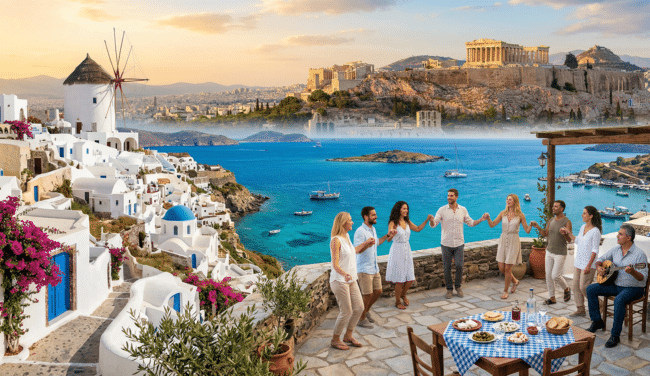
- Cycladic Architecture: The dazzling white-washed houses with blue domes (like on the islands of Santorini and Mykonos), designed to reflect sunlight and keep interiors cool, alongside the iconic windmills.
- Venetian and Ottoman Influences: Islands like Corfu and certain areas in Crete feature romantic alleys, fortresses, and houses in Venetian and Italian styles, while northern Greece shows distinct Ottoman influences.
- The Tower Towns: In the Mani region of the Peloponnese, you will find unique settlements built from fortified stone towers, which were used for defense during historical clan feuds.
Culinary and Philoxenia
Greek cuisine is much more than food or a collection of recipes—it is the beating heart of society and a clear expression of the sacred tradition of hospitality, known in Greek as Philoxenia (love of strangers). Every meal around the table at a local taverna or a family home is a vibrant social ritual that sanctifies togetherness, conversation, and the love of life.
This culinary culture is deeply rooted in the concept of Meze—serving and sharing an abundance of small plates in the center of the table to encourage sharing, closeness, and quality time. These are always accompanied by the clinking of glasses filled with traditional drinks like Ouzo, Tsipouro, or local wine, to the joyful cheers of “Yamas!” (Cheers!).
Beyond the warm and inviting atmosphere, Greek cuisine is the quintessential embodiment of the Mediterranean diet, relying on the freshest, highest-quality ingredients the local nature has to offer: rich olive oil flowing like water and forming the base of every dish, sun-drenched vegetables, fragrant herbs like oregano and thyme, fresh seafood just pulled from the nets, and wonderful sheep’s milk cheeses, crowned by the traditional Feta.
From the deep, comforting aromas of classic dishes like Moussaka and Pastitsio, through iconic street food like Gyros and Souvlaki, to crispy phyllo pastries and desserts dripping with honey and nuts—the culinary experience in Greece is not just a feast for the palate, but an accurate reflection of the Greek soul itself: unpretentious, generous, authentic, and full of love.