
The Acropolis of Athens is not just a site you visit to check off a list. It is a place that defines the entire city—geographically, historically, and conceptually.
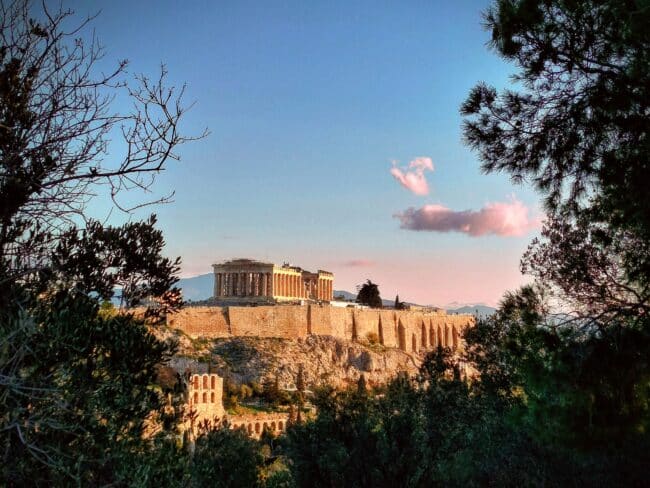
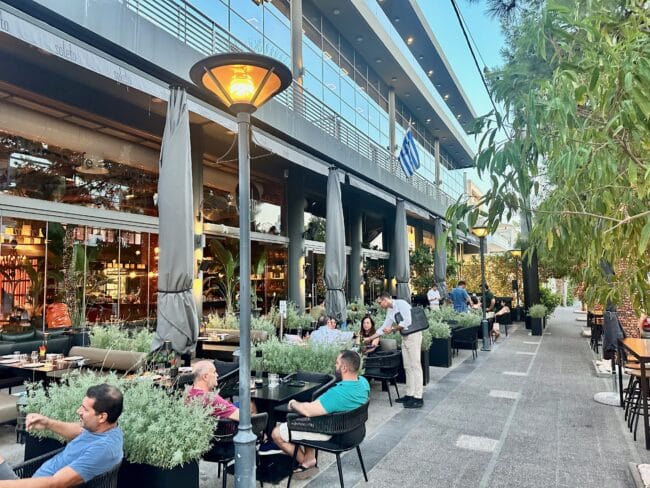
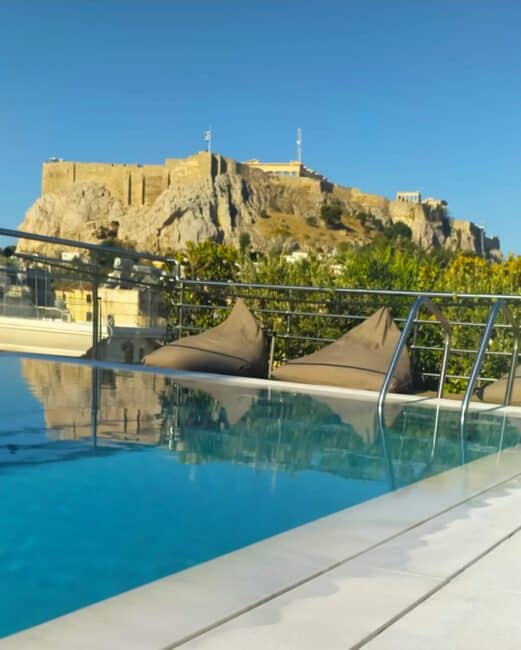
One high limestone rock, upon which a complex of temples was built, becoming over the years a symbol of culture, and even of civic and urban character. A visit here is not merely an encounter with antiquities, but with a worldview: how the city sees itself, what it chooses to place at its center. The Acropolis is not disconnected from the surrounding city—it is constantly present, visible from restaurants, hotel pools, and the main streets of the city.
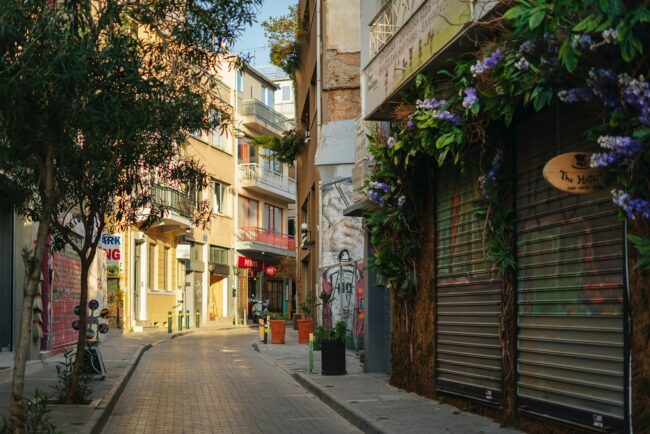
The Acropolis is located in the heart of Athens, rising to a height of about 156 meters above sea level, and is visible from almost every point in the city. Spread around it are old and fascinating neighborhoods like Plaka, Thiseio, Koukaki, and Monastiraki, which have existed for generations in the shadow of the mountain. This is not a site at the edge of the city, but rather a physical and symbolic center alike. A permanent point of reference that organizes the urban space around it.
The complex itself is a pedestrian-only zone, built of open plazas, gates, and temples, with a design that directs movement and gaze. The ascent to it is gradual, almost ceremonial, and the structures are not revealed all at once but are exposed step by step. The atmosphere is exposed to the wind and sun, to the light and the sounds of the city rising from below, and there is no attempt to soften the experience; on the contrary, there is a sense of an open, high, and clear space.
Beyond being a historical site, the Acropolis also functions as an active part of today’s city. It is present in the skyline, enters the frames of streets, appears between buildings, and accompanies movement in the city in almost every direction. By day, it stands out in rough white under the strong light of Athens, and by night, it is illuminated and becomes a quiet focal point above it. Thus, even without visiting it, it is hard to ignore. It is an inseparable part of the experience of Athens as a whole.
The Acropolis and the Parthenon – What is the difference?
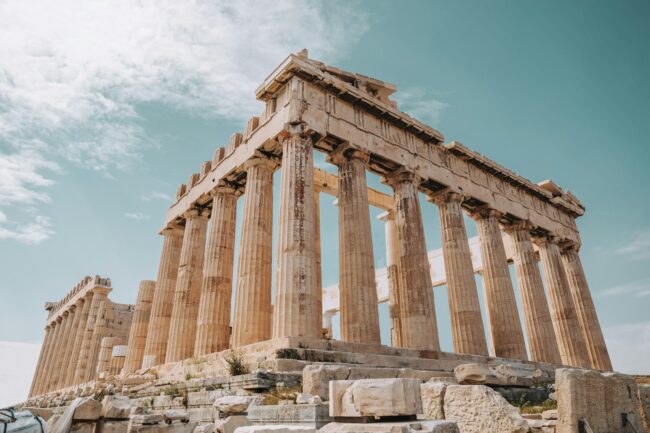
The Acropolis and the Parthenon are often mentioned with the same meaning, as if they were synonymous, but in practice, they are two different sites. The Acropolis is the mountain and the entire complex—a high platform upon which a complex of ceremonial, religious, and civic structures was built. The Parthenon is the central structure within the complex, the largest and most important temple, dedicated to the goddess Athena, which over the years became the universal symbol of Athens and of classical Greece.
Around it are other structures: the Erechtheion, the Propylaea, the Temple of Athena Nike, and open spaces intended for processions, ceremonies, and movement. A visit to the Acropolis is a walk through an entire complex, where the Parthenon is the focal point—but not the whole story.
The History and Character of the Place
The first settlement on the Acropolis hill began as early as the third millennium BC, when the high rock served as a natural vantage and defense point. During the Mycenaean period, fortifications and a palace were built here, but the complex gained its deep cultural significance only centuries later, when Athens became a central power in the Greek world.
The defining moment arrived in the 5th century BC, during the time of Pericles, after the Persians destroyed the site in 480 BC. Instead of partially restoring it, a broad and ambitious decision was made: to rebuild the Acropolis as a complete complex, not just as a place of worship but as a clear statement of identity, power, and culture. The construction, funded by the Delian League, included the Parthenon, the Erechtheion, the Propylaea, and the Temple of Athena Nike—all meticulously planned, with mathematical and aesthetic precision that expresses a worldview of order, balance, and control.
But the Acropolis did not remain frozen in that classical period. Over the generations, it changed its role time and again, depending on the regimes and religions that ruled the region. In the Byzantine period, the Parthenon became a church, in the Ottoman period a mosque, and at a certain point, it even served as an ammunition depot. The massive explosion in 1687, during a Venetian siege, caused particularly heavy damage to the Parthenon and other structures. Also in the 19th century, with the establishment of the modern Greek state, the Acropolis underwent complex processes of dismantling, conservation, and reconstruction, including the removal of later additions in an attempt to “restore” its classical appearance.
The character of the Acropolis today stems from all these layers together. This is not just an archaeological site, but a place where one can see how different cultures used the same space and charged it with different meanings. Alongside this, there is also a modern attempt at precision: ongoing conservation work, the use of the same types of marble, and careful reconstruction that tries to distinguish between the original and the new additions. The result is not a full reconstruction, but a delicate balance between past and present.
Beyond history, the Acropolis also has a very clear character as a space. It is an open, exposed place, with almost no shade, where light plays a central role. There is no attempt here to create comfort or intimacy, but on the contrary—a sense of space, height, and dominance over the landscape.
The structures are not disconnected from each other but create a system of relationships: between gaze and movement, between entrance and exit, between what is seen up close and what is revealed from afar. Even today, as thousands of visitors ascend it daily, the Acropolis retains the character of a place that asks you to pause for a moment, look around, and understand that it is not just a remnant of a distant past, but a starting point for understanding what a city and a culture are.
Visiting the Acropolis – Inside or Outside
A visit to the Acropolis does not boil down to the question of whether to enter or not, but rather to two different experiences of the same place. You can buy a ticket, climb up to the complex, and walk among the structures up close—pass through the Propylaea, stand in front of the Parthenon, and see the Erechtheion and the entire complex at eye level. This is a very direct experience: walking on the rock, a sense of height, strong light and wind, and a physical encounter with structures usually known only from pictures. For those who want to understand the place deeply, to see the proportions and the connections between the structures, this is the obvious way.
You can arrive completely independently, and that is what many do. The site is easy to navigate, and walking through it is intuitive. Those who prefer context and explanations can join morning or evening tours, which organize the historical and architectural story and focus the gaze. But it is not obligatory—an independent visit allows you to stop whenever you want, stay another moment in front of the Parthenon, or combine the ascent with the Acropolis Museum and a walk in the nearby neighborhoods.
At the same time, there is another way to experience the Acropolis: to approach it, walk around it, and view it from the outside. The Acropolis is present in the city even without climbing it, and sometimes the slight distance actually makes it possible to understand the complex in its entirety. From the roofs of restaurants and bars in Plaka and Makrygianni, from the promenade of Thiseio, or from the paths of Filopappou Hill, a wide view of the entire mountain opens up. Here, you see the Parthenon and the other structures as part of the city, and not just as a separate attraction.
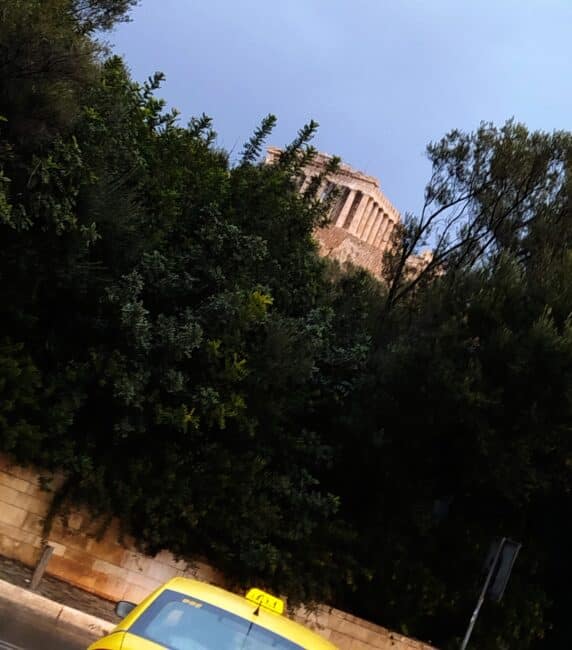
This is a different experience: fewer explanations, more observation. By day, the light highlights the stone and the sharp lines of the structures. By night, when the Acropolis is illuminated, it becomes a quiet focal point above the city. Sitting on a roof or a bench, looking at it without rushing, and seeing how it blends into the life of Athens—this is a simple but precise way to understand the place.
In practice, you don’t have to choose. Many combine the two: a short visit inside, and then returning in the evening for a view from the outside. This way, you get both the proximity and the context—both the structures themselves and their presence within the city.
Suitability for Different Audiences
- Couples will find an intimate and concentrated experience at the Acropolis, especially in the early morning hours or towards sunset. The shared ascent, the view that opens up all at once over the city and the sea, and the walk among timeless structures create a quiet yet emotionally charged experience.
- Families with relatively older children will discover a site that allows for a clear and tangible story: gods, myths, wars, and inventions. It is a place where it’s easy to turn history into something that can be seen and imagined, especially if you combine the visit with the Acropolis Museum and explain the connection between the statues and the structures themselves.
- Groups and culture enthusiasts will appreciate the Acropolis as a multi-layered site. It is a place that rewards prior knowledge but also raises new questions: about politics, architecture, the use of public funds, and the way a city presents itself to the world.
- Independent travelers and city lovers will find a point of reference here. The Acropolis provides context for understanding the whole of Athens—from the neighborhoods surrounding it to how the city operates today. It is a place from which you can continue on foot, without a clear plan, and let the city unfold at a personal pace.
Attractions and Things to Do Near the Acropolis
- The Acropolis Museum: One of the most important places to combine with the visit is the Acropolis Museum, located right at the foot of the mountain. It is not a complementary museum but part of the experience itself. Here you can see the statues, reliefs, and details that were removed from the site and are kept under controlled conditions, including a partial reconstruction of the Parthenon and an accurate presentation of what was on it. The modern space, with glass floors and open walls, also allows for a direct view of the Acropolis itself, making the connection between the artifacts and the place clear and immediate.
- Circular Walking Route: Walking around the Acropolis is an inseparable part of the experience. The pedestrian path that circles the mountain connects central areas of the city and creates a natural and pleasant route: from Thiseio, through Monastiraki, to Plaka and Makrygianni. This is a wide, paved, and comfortable walk, with viewpoints, stops for coffee, street musicians, and local movement. You don’t need to plan too much—just walk, stop, and let the city open up around the Acropolis.
- The Agora: The Ancient Agora is located on the northwestern side of the Acropolis, completing the story from a civic perspective. If the Acropolis was the religious and ceremonial center, here was the public heart of ancient Athens—a place of markets, discussions, politics, and daily life. The area is spacious, relatively green, and includes well-preserved structures like the Stoa of Attalos and the Temple of Hephaestus, which is considered one of the best-preserved temples in Greece.
- Filopappou Hill: One of the most beautiful viewpoints in the city, a short walk from the Acropolis. Pleasant trails lead to the top of the hill, opening up to a sweeping view of the Acropolis, Athens, and the sea. An excellent place to visit at sunset or in the evening.
Restaurants and Culinary
The area around the Acropolis is full of traditional and modern restaurants, and many of them manage to combine a central location and wonderful views with true culinary quality.
- Dionysos Zonar’s – An elegant restaurant facing the Acropolis, with an open view of the Parthenon and a slightly festive atmosphere. The menu features classic Greek dishes with a modern twist, fish, seafood, and meats, alongside local wines. Especially suitable for a relaxed dinner with a view.
- Arcadia – A modern tavern in Makrygianni, a short walk from the Acropolis, with a lively and effortless atmosphere. The menu offers regional Greek dishes like meatballs, cheeses, salads, and meat dishes, alongside vegetarian options, with an emphasis on simple, precise, and local food.
- Scholarhio – A long-standing tavern in Plaka with a warm traditional atmosphere, pleasant seating, and a classic Greek menu based on home-style dishes and meze, including moussaka, dolmades, fried zucchini, calamari, and fried goat cheese with fig jam. It is a more pleasant spot than many tourist traps in the area, with a more local character and simple, good food.
- Yiasemi – A small, local cafe in Plaka, with staircase seating and a relaxed, almost rustic atmosphere in the heart of the city. The menu includes coffee, tea, pastries, and simple Greek desserts, making it an excellent place for a light break or a slow morning start.
- Mani Mani – A high-quality local restaurant in Makrygianni that focuses on the cuisine of the Mani region in southern Greece, with a modern approach to traditional dishes. The menu features fish, meats, vegetables, and meze that are more precise than the tourist standard, and the atmosphere is elegant yet unpretentious.
Accommodation (Hotels and Apartments)
Accommodation around the Acropolis includes a vast variety of boutique hotels and urban apartments within walking distance.
- Herodion Hotel – A four-star hotel in an excellent location near the Acropolis Museum, with a roof looking directly at the Parthenon and comfortable, quiet rooms. Especially suitable for couples and those who want to be within walking distance of the main site.
- Acropolis Select Hotel – A modern and comfortable hotel in the Makrygianni area, a few minutes’ walk from the Acropolis and the metro. The rooms are simple but pleasant, and the atmosphere is relaxed and suitable for a comfortable urban stay.
- Plaka Hotel – A pleasant and economical hotel in the heart of Plaka, with an open roof and views of the Acropolis. The central location allows you to walk everywhere in the area, perfect for those who want to be right in the action.
- NLH Fix Neighborhood Lifestyle Hotels – A modern boutique hotel with spacious rooms and clean design, in a great location between the Acropolis and local neighborhoods. Suitable for a slightly longer stay or for those seeking comfort with character.
- Acropolis View Hotel – A small and intimate hotel in a relatively quiet area, with a terrace and direct views of the Acropolis. Suitable for those looking for a calmer atmosphere while still being close to all the attractions.
- SV Acropolis Residence – Modern and spacious apartments in an excellent location near the Acropolis, with a clean design, a fully equipped kitchen, and some featuring a balcony or mountain view. Particularly suitable for an independent stay for couples or families who want more space and convenience.
Transportation and Getting There
The most convenient way to arrive is by metro. The Acropoli station (Line 2) is a short walk from the entrance. Additional stations: Monastiraki (Lines 1 and 3) and Thissio (Line 1). Access to the site itself is solely on foot.
מתוייג ב:
Attractions | Urban