

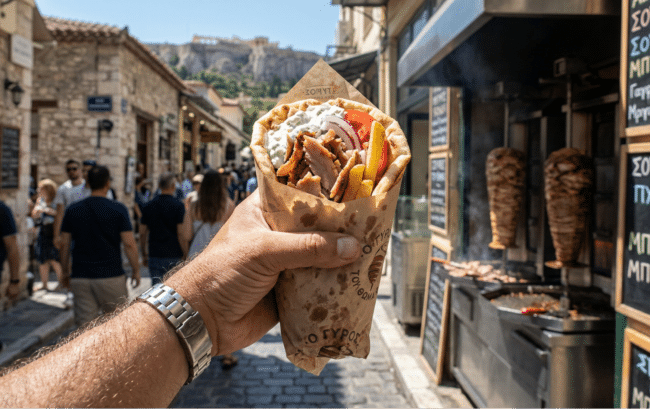
Gyros is essentially the “shawarma” of Greece, and alongside souvlaki (meat skewers in a Greek pita), it is the most popular street food across the country. Whether it’s a bustling city like Athens or Thessaloniki or a small Greek village, you will almost always find a stand or restaurant with a spinning spit exuding the addictive aroma of roasted meat, where locals and tourists alike all want to enjoy a good serving of gyros from time to time.
Gyros is much more than just “fast food”; it is truly a pillar of Greek street food culture, a dish that manages to be simultaneously simple and affordable, yet highly craved at almost any hour of the day. For visitors from the Middle East or those familiar with Turkish döner or shawarma, encountering gyros might feel familiar. However, as you dive deeper into the world of gyros, you discover that it is something quite different—in its cutting, presentation, seasoning, and ingredients, coming with a whole world of unwritten rules, flavor combinations, and long-standing traditions.
In this guide, we will understand a bit more about where gyros came from, how to eat it, what you should know, and where you can find high-quality, authentic gyros across Greece. Happy eating! 🙂
The History of Gyros
Although gyros gives the impression of being an ancient Greek dish that has always been there, gyros in its modern format only arrived in Greece in the 20th century. Similar to shawarma, the roots of the Greek gyros are embedded in the vertical roasting method that developed in the city of Bursa, Turkey (“döner kebab”). It is estimated that the arrival of gyros in Greece occurred around 1922, following the population exchange between Greece and Turkey. Greek refugees arriving from Asia Minor/the Ottoman Empire (modern-day Turkey) brought with them to Greek cities the knowledge and tradition of the vertical spit, and the Turkish “döner culture” entered Greece in full force, just as it did across the Middle East.
In the 1950s and 60s, gyros underwent a complete Greek adaptation. While in neighboring Muslim countries, döner or shawarma were almost always based on lamb, and rarely chicken or beef, the Greeks adopted pork—a meat they deeply love—as the main ingredient for gyros. This was a sort of “cultural statement” that distinguished the Greek gyros, and Greek cuisine in general, from its neighbors. At that stage, it was still referred to as döner, but in the 1970s, the dish was officially given the name “gyros,” which means “turn” or “revolution” in Greek.
This adaptation in the 50s and 60s wasn’t just culinary but also a cultural and religious statement setting Greek cuisine apart. The choice of pork became the standard. The name “Gyros,” serving as a Greek alternative to the Turkish “döner,” became the official title in the 70s. Today, gyros is a source of national pride, with every region in Greece boasting its own unique seasoning.
What Characterizes Authentic Greek Gyros?
Unlike Middle Eastern shawarma, Greek gyros is characterized by a few critical elements:
- Meat Type: Classic gyros is pork, followed by chicken. Beef or lamb are very rare at traditional gyros stands in Greece.
- Seasoning: Greek cuisine relies heavily on dried herbs. The base seasoning will always include oregano, salt, black pepper, crushed garlic, and sometimes sweet paprika or cinnamon (especially in Northern Greece).
- The Pita: Greek pita is round, relatively thick, soft, and pocketless. It is grilled with a little olive oil until it gains flexibility and a smoky flavor.
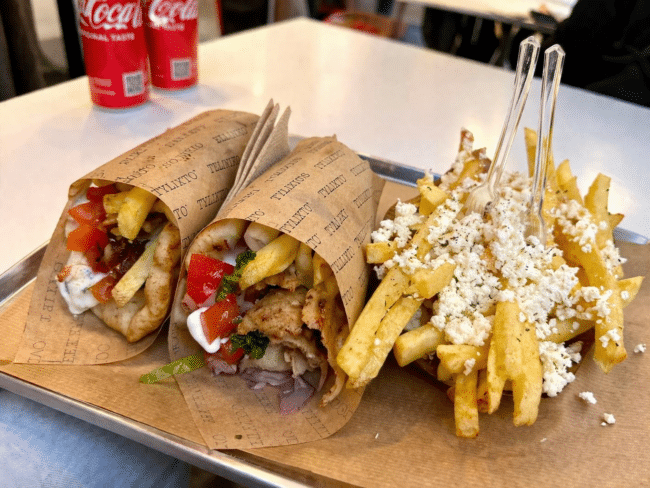
- French Fries: In Greece, fries are an inseparable part of the dish and go inside the pita, although there is a long-standing debate about this, with some arguing that true gyros is served without fries. The fries absorb the meat juices and sauces, adding another texture to the dish. The fries also have their own special seasoning. In a plated gyros or takeout box, you will usually get thinly sliced fries or sometimes seasoned potato wedges (Patatas sto Fourno).
Common Terms in the World of Gyros
- Gyros vs. Souvlaki – The most common confusion. While gyros is meat sliced from a spinning spit, souvlaki refers to small meat skewers grilled over an open flame. In Greece, when ordering “souvlaki in a pita,” it means the skewer is removed from the stick and placed inside the pita.
- Pita me ola – “Pita with everything.” This usually means onion, tomato, fries, and sauce (e.g., tzatziki for pork, or a mayonnaise-based sauce for chicken).
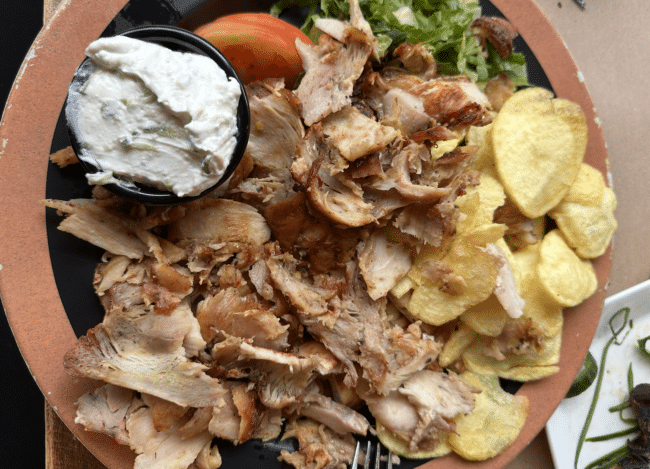
- Merida – Serving gyros as a plated dish. The meat portion is at least twice as large, accompanied by a pile of cut pitas, fries, and salad.
- Tzatziki – The legendary spread based on thick Greek yogurt, cucumbers, garlic, and olive oil, sometimes with herbs. This is the classic accompaniment to pork gyros.
How Do You Eat Gyros?
Eating gyros is a true ritual. If you chose the pita gyros format, the proper way is to eat it standing up or sitting at the bar, wrapped in parchment paper that prevents the sauces from dripping. The secret is not to completely unwrap it, but to peel it layer by layer as you eat.
What to Drink With It?
The ultimate pairing is a cold Greek draft beer (Fix, Mythos, or local craft beers). Alternatively, Greeks love to pair gyros with local lemon or orange flavored sodas (Loux or Epsa).
What to Eat Alongside It?
If you ordered a “Merida” (plate), it is customary to order a Greek salad (Horiatiki, “village salad”) and feta cheese with olive oil and oregano for the center of the table. The combination of warm meat, salty cheese, and fresh vegetables creates a balanced culinary experience.
Recommendations for Great Gyros Across Greece
Gyros is the most popular dish in Greece. It suits backpackers looking to get full on a budget, families with children who love the combination of meat and fries, and foodies seeking quality in simplicity. It is a perfect solution for a quick meal without compromising on fresh ingredients.
The following lists feature gyros we have tasted ourselves. There are, of course, tens of thousands of gyros shops and stands across Greece. Don’t walk in without checking Google Maps reviews first.
Recommended Gyros in Athens
- Achilleas – A true local gem in the Neos Kosmos neighborhood area, relatively close to central Athens. You won’t find tourists here, but rather a line of locals waiting for handmade pork gyros considered one of the best in the city. The meat is sliced extra-thin, and the seasoning is secret and precise.
- Grillaki – Also located in the bustling Monastiraki area and considered a must-stop for meat lovers, thanks to the combination of a casual “street food” vibe and restaurant quality. The place excels in a special veal gyros and juicy souvlaki skewers, with the highlight being the precise seasoning and pitas grilled to perfect crispness.
- Tylixto – Located on the vibrant Aiolou street near Monastiraki Square, offering a modern, high-quality interpretation of traditional gyros with an emphasis on exceptionally fresh ingredients. Known for its juicy chicken and pork gyros served in a soft handmade pita. It’s also highly recommended to try the halloumi gyros and the fries topped with feta.
Recommended Gyros in Thessaloniki
- Liga ke Kala – A classic Thessaloniki institution operating for decades, boasting a limited menu (“a few and good,” as its name suggests). The gyros here is among the most traditional in the city, hand-cut from high-quality meat, and served in a large round bread (the famous Thessaloniki sandwich) with very few toppings to let the meat shine.
- Mimis – Considered one of Thessaloniki’s “roots” spots. Its uniqueness lies in the simplicity and quality of the pork gyros, roasted to perfection. This is where locals stop for a quick bite in the heart of the city’s shopping district, representing the simple, good gyros of the past without gimmicks.
- Grill 105 Street – A bit of a “local secret.” Known for its classic pork gyros, considered one of the best in the area, with excellent meat quality.
Recommended Gyros in Northern Greece and the Peloponnese
- Savvas Best Gyros – A culinary institution in northeastern Greece, in the city of Kavala, whose reputation precedes it. The owner prepares the gyros with obvious passion, and the place is known for exceptionally high-quality meat cuts and seasoning that preserves the meat’s original flavor. A must-stop for anyone traveling towards Thassos Island or East Macedonia.
- Polykarpos – Ioannina is known for its meat tradition, and Polykarpos is the undisputed king of souvlaki and gyros in the area. Famous for its lamb/lamb-pork gyros—a Northern Greek specialty—and hand-cut, perfectly fried chips.
- Souvlakia o Tzimis – In the heart of the old town of Kalamata in the Peloponnese, you’ll find this colorful spot serving Greek street food at its finest. The gyros here is known to be very juicy, and the atmosphere in the square next to the church adds to the authentic experience. Locals often sit here with a cold beer to enjoy a classic pork gyros.
Recommended Gyros in the Islands
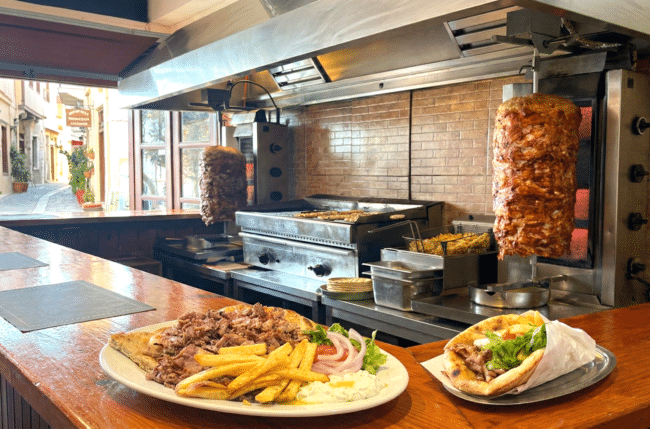
- Lucky’s Souvlakis – Located in the heart of Fira on the island of Santorini. Although Santorini is very expensive, Lucky serves excellent gyros at a fair price, is known for his juicy meat, and has become a local gyros institution over the years.
- Lefto’s Souvlakis Kebab House – A wonderful place known for local ingredients. The meat comes from a Naxos farmer, and the fries are made from the island’s famous potatoes.
- Kellides – Gyros Pitta Souvlaki – An authentic spot in the city of Rhodes providing a true Greek experience with warm pitas and superbly roasted meat.
- Oasis– A hole-in-the-wall on Voloudaki 4 street in Chania (Crete) that has existed since 1968. The place specializes exclusively in pork gyros, without fries (the traditional style), with yogurt instead of tzatziki. It is open only until the meat runs out (usually around 3:00-4:00 PM).
Important Tips
- Identifying Quality Meat: If the spit looks too smooth and symmetrical (like a sausage), it is processed meat. A high-quality spit is made of visible layers of meat cuts. By the way, this is also a great way to distinguish between processed döner and quality shawarma across Europe (for example in London).
- Timing: The best gyros is eaten in the late afternoon (2:00-4:00 PM) or early evening, when the meat is fresh and turnover is high.
- Avoiding Tourist Traps: Don’t eat gyros at restaurants with “tourist hunters” outside. The good spots are usually small, simple, and packed with Greeks.
Gyros is not just food; it is a way of life. It connects the history of the refugees to modern, vibrant Greece. Whether you are eating at “Achilleas” in Athens or “Lucky’s” in Santorini, for instance, you are tasting a piece of the Greek soul. Yes, Greek cuisine is rich and full of special dishes, but there is no doubt that a good gyros is something you must eat in Greece at least once or twice, as it is an inseparable part of Greek culture.
מתוייג ב:
Food & Drink