
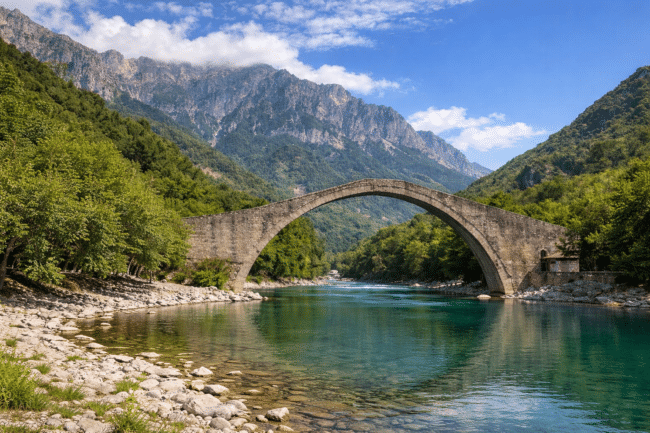
Plaka Bridge is one of the most impressive and moving sites in Northern Greece. Its massive stone arch stretches over the deep gorge of the Arachthos River, in the heart of a wild and green mountainous landscape, creating a dramatic sight that is hard to remain indifferent to. It is a place that tells a story of human audacity, traditional engineering knowledge, and rural life woven over centuries around the steep mountain passes of Epirus.
The bridge is located in the Epirus region, in the Tzoumerka area, near the village of Plaka and on the historical border between Ioannina and Arta. The region is mountainous, forested, and characterized by relatively isolated small villages, with the bridge serving for years as a vital crossing point between communities living on both sides of the river. Today, it is a sought-after destination for travelers, nature lovers, and photographers, yet it still maintains a feeling of the edge of the world and rural tranquility.
History
Plaka Bridge was built in 1863 by the master builder Kostas Bekas, one of the last great artists of stone bridge construction in Epirus. It was rebuilt after a previous collapse, quickly becoming the largest single-arch stone bridge in the Balkans at the time. For decades, the bridge served not only as a transport crossing but also as a border and trade point.
In 2015, the bridge collapsed again due to an extreme flash flood, an event that shocked all of Greece. A meticulous and lengthy restoration process, based on historical documentation and traditional building methods, was completed in 2020, returning the bridge almost entirely to its original form.
Interesting Fact
The bridge’s arch was built without the use of modern cement, relying instead on the perfect fitting of hewn stones and precise weight distribution. The span of the arch reaches about 40 meters, and the height above the river is particularly impressive. Even today, engineers consider Plaka Bridge a prime example of the ability of traditional construction to withstand extreme natural conditions over time.
Main Sites and Attractions Nearby
Arachthos River
The river flowing beneath the bridge is considered one of the most beautiful in Epirus. During the spring and summer seasons, you can find natural swimming spots, while in other seasons it attracts rafting and kayaking enthusiasts thanks to its strong flow and dramatic gorge.
Tzoumerka Region
Tzoumerka is a wild mountainous region in southern Epirus, an expanse of sharp ridges, dense forests, and deep valleys carved by rivers like the Arachthos, giving the area a rare sense of isolation and quiet, even by Greek standards.
Large parts of Tzoumerka have been declared a national park (Tzoumerka National Park) that preserves a dramatic mountainous landscape, narrow canyons, wild river sections, and hiking trails crossing almost uninhabited areas.
Scattered within this space are traditional mountain villages, known for their stone houses and surrounded by forests, waterfalls, and hiking trails. The most prominent is Pramanta in the center of the region.
Recommended Hotels
Accommodation in the area is based on small guesthouses, villas, and apartments in villages like Pramanta and Syrrako. The buildings are made of stone, the rooms are relatively simple, and the atmosphere is very quiet. There are no large luxury complexes or resort services, but rather functional accommodations that serve as a base for mountain trips, including a selection of hotels, as well as family villas.
- Rouista Tzoumerka Resort – A high-quality mountain resort with spacious rooms, a restaurant, and open views of the Tzoumerka mountain range.
- Hotel Teloneio – A small rustic hotel with a traditional atmosphere, serving as a convenient base for visiting the bridge and the river area.
- Gefiri Plakas Hotel – Comfortable rooms with views of the village or the mountains.
- Sylvia’s Pramanta Villas – Well-kept rural hospitality villas in the heart of Pramanta, offering spacious apartments, fully equipped kitchens, and balconies facing the mountainous landscape of Tzoumerka.
Recommended Restaurants
The food in the area is rustic and traditional, with an emphasis on grilled meats, local stews, and pies. Most restaurants are small family tavernas, without complex menus or modern cuisine. The meals are simple, generous, and the service is warm and familial.
- Taverna Gefiri Plakas – A local taverna near the bridge, serving rustic Greek food, grilled meats, and traditional stews.
- Stou Ziavra – A local taverna right by Plaka Bridge.
- Boútzas – Grillhouse – A well-known local grillhouse in Pramanta, specializing in mountain-style grilled meats, kebabs, ribs, and generous portions.
- Tsipouradiko – A taverna specializing in Tsipouro, a local alcoholic beverage distilled from grapes, poured into small glasses and accompanied by a continuous sequence of small mezes that arrive gradually at the table.
How to Get to the Bridge?
Getting to the bridge is possible by private vehicle only. If you are renting a car, you can arrive from Ioannina or Arta through winding mountain roads, following the signs towards Plaka Bridge. It is highly recommended to travel during daylight hours and in good weather conditions, as the roads are narrow and the terrain is highly mountainous.
מתוייג ב:
Attractions | Guides | Rustic | Trip Planning