
Greece is so rich in culture and natural beauty that it is a must-visit destination at least once in a lifetime! With thousands of years of history and attractions suitable for all ages and family types, it is no exaggeration to say that Greece is a true paradise on earth. If you are planning a visit, here is a list of the most frequently asked questions we receive, along with all the answers you need.
No, citizens of many countries are exempt from obtaining a visa for tourism or business purposes when visiting Greece and other countries within the Schengen Area. This exemption allows for a stay of up to 90 days within any 180-day period.
However, it is mandatory to ensure that your passport is valid for at least 3 months beyond your intended date of departure from Greece. Please note that travel requirements are subject to change in the coming years; soon, travelers from visa-exempt countries may be required to obtain an electronic travel authorization (ETIAS) prior to their flight.
Global Entry Requirements
EU and Schengen Citizens: Citizens of European Union member states and Schengen-associated countries enjoy full freedom of movement and do not require a visa under any circumstances.
Visa-Exempt Countries: Holders of passports from countries such as the United States, United Kingdom, Canada, Australia, and Israel are exempt from visas for short stays of up to 90 days.
Visa Required: On the other hand, passport holders from countries not included in the exemption list (such as Russia, Turkey, China, and others) must arrange a visa through a Greek embassy or consulate prior to their trip.
The fastest and most convenient way to get to Greece is by plane. There are direct flights from most major airports to various cities and islands throughout Greece. One of the popular ways to see as much of Greece as possible in a short time is a vacation cruise. Thanks to the sea surrounding Greece and the thousands of beautiful islands, a cruise allows you to visit several destinations in a short period while you “travel” at night on your floating hotel. It is no coincidence that Greece is repeatedly considered the best cruise destination in the world.
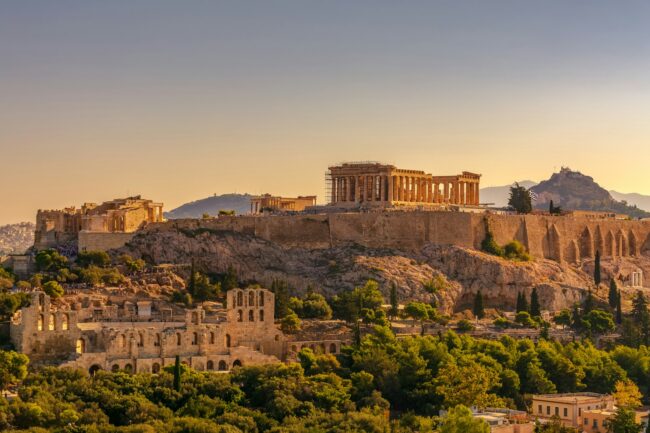
It is impossible to see all of Greece in a single visit, especially if it is your first time. Therefore, the recommendation is to choose a few regions or islands and spend at least a day or two in each. In any case, do not settle for a trip of less than a week to Greece. In one week, you can combine a visit to major ancient sites, such as the Acropolis in Athens, Delphi, Mycenae, while also spending a few days on one or two islands to enjoy the beaches and the atmosphere. If possible, add a few more days to discover additional Greek cities and heritage and archaeological sites.
If you land at Athens International Airport or any of the other airports across Greece, you can continue to your destination by taxi, public transportation, rental car, or private transfer services directly to your hotel or the ferry and boat piers. During the trip itself, people travel via public transport, taxis, rental cars, and organized tours to reach ancient sites, food markets, tavernas, and beaches.
The Port of Piraeus is the main gateway for Athens, where many ferries, yachts, and cruise ships dock. From there, and from other ports throughout Greece, sailings depart to numerous islands, less-visited villages in the Peloponnese, and other regions across Greece.
Greece is a member of the European Union, and its official currency has been the Euro since 2001. It is recommended to bring some cash with you from the start for a more relaxed beginning to your trip. Banks generally offer the best exchange rates; they are usually open between 9:00 and 14:00. However, the simplest and most common way to obtain Euros is to withdraw cash from ATMs located almost everywhere throughout Greece.
Be sure to carefully check the withdrawal fees. They can sometimes amount to several dollars or euros per transaction!
In Greece, cash still holds a significant advantage. While most hotels, large stores, and many restaurants in cities will offer the option to pay by credit card, smaller businesses, family-run tavernas, and small villages often accept only cash.
Greece enjoys a pleasant Mediterranean climate with four seasons and plenty of sunshine throughout most of the year. The summer is generally hot and dry, while the winter is cool and rainy. Spring is pleasant and sunny. Autumn, especially in the south and on the islands, often feels like a continuation of the summer. You can view the weather forecast for today and the coming days here.
The best time to travel to Greece and the islands is during the autumn, from September to mid-October, or in the spring and early summer, from mid-April to mid-June. During these seasons, the weather is generally pleasant, the sea is either still or already relatively warm, and everything is less crowded than in July and August. In the summer months, and especially in August, there are occasional heatwaves with temperatures reaching around 40°C.
The official language of Greece is Greek, but almost everyone working in the tourism industry speaks good English. English is taught as part of the school curriculum, so most young Greeks are able to communicate in English, and often in other European languages as well. Greek is considered a challenging language to learn, so no one will be upset if you do not speak it. On the contrary, Greeks are known for being warm and welcoming, and they are very happy to hear tourists try to say even a few basic words in their language. It is worth learning a few useful phrases like please (Parakalo), thank you (Efcharisto), and hello (Yassou) – this will almost always earn you a smile and a warm response.
In most cities, street and road signs are bilingual, in both Greek and English. If you plan to travel to more remote areas, it is helpful to familiarize yourself at least with the letters of the Greek alphabet so you can recognize place names and navigate more easily.
Greece is considered one of the safest countries in the world for tourists. Nevertheless, as with any trip, it is advisable to exercise basic common sense and take standard precautions. Keep an eye on your valuables, avoid keeping your wallet in your back pocket, and be cautious of pickpockets, especially in crowded areas like Athens, on public transportation, and at major tourist sites.It is also worth being mindful of potential scams by transport and taxi drivers at airports and seaports. Use only licensed taxis, international services like Uber, or public transportation.
Greece is an extremely child-friendly destination and is considered one of the most pleasant places in the world for family travel. The weather is generally pleasant, there are many “Blue Flag” beaches with clean and relatively shallow waters, and plenty of activities suitable for children of all ages, such as swimming, snorkeling, beach games, and building sandcastles.Additionally, Greece is full of historical and mythological sites that can turn learning history into a vivid and fascinating experience. In Ancient Olympia, for example, children can run on the original Olympic track, hear stories about the Greek gods, make their own olive wreaths, and hold family “Olympic competitions.” Beyond the classical sites, there are also medieval fortresses and castles to explore, for instance in Nafplio, Chlemoutsi, and Methoni.
Whether you plan to spend most of your time lounging on the beach or exploring the historical sites of Greece, there are several items you shouldn’t forget: comfortable walking shoes, light and breathable clothing for the summer, sunglasses, sunscreen, and a wide-brimmed hat. Pack one or two swimsuits, flip-flops or water shoes (especially if you plan to visit pebbly beaches or volcanic shores like those in Santorini), and a light sweater or jacket for cool evenings or air-conditioned spaces. Don’t forget a power adapter for the electrical outlets and, of course, a camera or a phone with plenty of memory, because you will likely be taking a lot of photos.
Traditional Greek cuisine relies on the products of the deep blue sea, the warm sun, and the rich soil. The result is an abundance of fresh and indulgent flavors. If you appreciate high-quality ingredients, you will find countless dishes to fall in love with: tzatziki, Kalamata olives, fresh olive oil, feta cheese, the classic Greek salad, and dishes like moussaka, vegetables cooked in tomato sauce and olive oil, and various vegetable stews. In the morning, you can sip a strong Greek coffee or a cold frappe alongside a fresh, warm cheese pastry like tiropita.
On the Greek islands, you will find an abundance of fresh fish and seafood: grilled octopus, fried calamari, shrimp in tomato sauce, and lobster pasta. Ouzo pairs perfectly with all of these, as long as it is served cold with ice.
In the street food department, souvlaki is considered the undisputed star of Greece; these are grilled meat skewers. Another popular option is gyros—pita bread filled with meat, vegetables, and tzatziki.
Greece has official public holidays. Some fall on fixed dates, while others vary from year to year. You can read more about this on the Greek holidays page
It is indeed advisable to stay near the Athens airport, especially if you land late at night or take off early in the morning. Located directly opposite the Athens airport terminal is the Sofitel Athens Airport, although its prices are relatively high. Sometimes, it is preferable to stay at a more comfortable and affordable hotel within Athens, enjoy the city, and simply take a taxi to and from the airport. The Holiday Inn is also just a short drive away and even offers free airport shuttles. You can find more hotels near the airport here.
By the way, the journey from the airport to central Athens takes time, primarily due to traffic. During off-peak hours, the trip takes approximately half an hour.
If you are not interested in seeing Athens and there is a convenient direct connecting flight to the island without a long wait at the airport or fear of missing a connection, an internal flight within Greece is a good solution. It is always recommended to leave at least 3 hours between flights.
If you are planning to spend your first night in Athens anyway, it is often more worthwhile to travel by high-speed boat or ferry. For example, a flight to the island of Mykonos takes about half an hour, but you will need to add about an hour’s drive to the airport if there is traffic, arrive an hour before takeoff, and take into account the journey from Mykonos airport to the hotel. On the other hand, if you take a high-speed ferry, you can reach the port of Piraeus by metro or taxi, board the ship in about 20 minutes, and be at the port of Mykonos within about two hours. For distant islands, assuming you do not like long voyages of 10 hours or more, it is usually better to fly. However, for any island that is within a 3-hour high-speed sail from Piraeus, the high-speed boat solution is often more convenient and better.
If you are debating between taking a night ferry with a cabin, a flight, or a high-speed ferry without cabins, it is better to take the night ferry. High-speed ferries do not have cabins; it feels like sitting on a plane for 6 hours and then paying for a hotel upon arrival. In contrast, on a night ferry, you eat dinner, go to sleep, and wake up in the morning directly at the island, without paying for additional accommodation. This option is particularly relevant for those planning to reach islands like Crete, Kos, Rhodes, Lesvos, Chios, and sometimes Santorini in the summer.
Hardly ever. The romantic sight of the past has been replaced by agents who work on commission. This type of accommodation is only suitable for very spontaneous travelers during the off-season. In July and August, when occupancy is at its peak, relying on finding a room at the port is a risky gamble. The universal recommendation today is to book your accommodation in advance to ensure you secure a room, and that it is both high-quality and fairly priced.
Overbooking exists in Greece, primarily during the peak season, but it is not common if you take the right steps. The highest risk is for those arriving at the hotel independently late at night. How can you avoid this? Only book hotels through major international sites like Booking.com or a reliable travel agent – in case of an issue, they are obligated to find you an alternative hotel. If your flight lands at night, it is mandatory to inform the hotel in advance. Without notification, the hotel may assume you are a “no-show” and give the room away.
The best way is not to do it blindly but to seek help from someone who knows the city. Without guidance, you might find yourself in a neighborhood that is remote, unpleasant, or inconvenient for tourists. Recommended neighborhoods to stay in for a few days or weeks in Athens include Plaka, Pangrati, Kolonaki, Agia Paraskevi, Chalandri, Kifisia, Psychiko, Glyfada, Voula or Vouliagmeni.
There are plenty of options for day trips outside of Athens, some on the mainland and some on the islands. Delphi is a spectacular archaeological site nestled at the foot of Mount Parnassus, famous for its ancient Oracle. In the Argolis peninsula, you can wander through the majestic ruins of Mycenae and visit the picturesque and romantic port of Nafplio, which was the first capital of modern Greece.Among the nearby islands, Aegina is known for its wonderful pistachios and the ancient Temple of Aphaia. Poros is a charming island offering a beautiful view of the passage between the islands from its famous clock tower hill. Hydra is a car-free island where transportation is done by donkeys and water taxis, while Agistri is a small, green, and peaceful island, perfect for swimming and relaxing on beautiful beaches.From Athens, there are numerous sailing experiences that hop between several islands in the Saronic Gulf, including meals, island stops, and opportunities to jump into the water in the middle of the sea. If you prefer something shorter, take a half-day trip to the impressive Temple of Poseidon at Cape Sounion, which stands dramatically above the Aegean Sea and offers unforgettable sunsets. Finally, the beaches around Athens are easily accessible, allowing you to leave the city for a few hours of relaxation by the shore.
Santorini is considered a classic for a honeymoon, offering dramatic views, famous sunsets, and romantic hotels. Mykonos is more geared toward couples who also enjoy nightlife and entertainment. Sifnos is a great choice for those seeking a more authentic Greek atmosphere, peace, and romance, with good beaches and excellent food without completely giving up on a bit of a tourist vibe.
Certainly. There are several sites and services for booking ferries in Greece. Popular and reliable options include Ferryhopper, Ferryscanner, and FerriesinGreece.
Santorini is one of the most popular destinations in Greece, and therefore it is crowded, especially in the main towns. However, it remains one of the most impressive and photogenic places in the world. If you are looking for a quiet and authentic area in Santorini, you can stay in less-visited villages like Akrotiri or inland villages, and visit the busy areas only for a day trip or an evening out. For those truly seeking complete tranquility, it is recommended to visit a calmer island like Sifnos.
The voltage in Greece is 220V, and the outlets are the European standard (Type C/F) with two round pins. Travelers from most of Europe and Israel do not need a plug adapter or a voltage converter at all, as the voltage and plugs are identical or compatible.
In contrast, travelers from the United States (where the voltage is 110V) must check their devices: if the device is dual-voltage (110V-240V), only a small plug adapter (from two flat pins to two round pins) is required. If the device is designed for 110V only, a voltage transformer may be needed to prevent damage. It is worth noting that many hotels provide hair dryers in the rooms, and adapters can easily be purchased within Greece itself or before your flight.
Today, almost every hotel in Greece offers free Wi-Fi in public areas and often in the rooms as well. Additionally, many cafes, bars, and restaurants provide free wireless internet for customers, and there are even entire city areas with public networks. Still worried? Order an eSIM card for seamless connectivity.
Greece also experiences winter, with cold and rainy days alongside pleasant, sunny ones. The southern islands, such as Rhodes and Crete, generally enjoy a relatively mild winter, but it is certainly not summer. During the winter, the tourist season on the islands is very quiet or even non-existent, as a large portion of hotels, restaurants, and tourist businesses are closed.Those seeking an authentic Greek winter experience might actually prefer Athens or other large cities during this time, where they can enjoy the local atmosphere, cafes, and culture.
The average temperature in many parts of Greece is approximately 16°C. There can be relatively warm days where temperatures reach 20°C or even higher. In mountainous regions, you will find snow. Winter is the rainy season in Greece, whereas in the summer, there is almost no rainfall at all.
The most famous islands in the international party scene are Ios, Mykonos, and Santorini. There are also great nightlife hubs in Rhodes, Crete, Hydra, Paros, and Naxos.
It is important to remember that the parties on the islands are highly seasonal: during July and August, the atmosphere is intense and crowded, especially as both Greeks and Italians flock to these islands. However, by October, for example, the vibe is already much quieter and more relaxed.
In the past, many rental companies in Greece accepted the tourist’s national driving license, and many did indeed rent vehicles using only their home country’s license. In recent years, however, the authorities have tightened the rules, and the requirement to carry an International Driving Permit (IDP) has become official.
Legally, it is highly recommended to obtain an international driving permit in your home country before your trip. If you are stopped for a check without an international permit, you may be subject to a fine.
Most visitors from Western countries are not actually asked to present travel insurance upon entering Greece. However, even if no one asks to see it at the border, comprehensive travel insurance for Greece is a very good idea. It ensures you are covered medically and financially in case of an emergency, theft, lost luggage, and similar issues.
Yes. Both in the city center and at the port of Piraeus, there are various luggage storage services. Some are located within existing cafes or shops, and others are specialized locker facilities. Many hotels also allow guests to leave their suitcases at the hotel if they are traveling to the islands for a few days and returning to the same hotel afterward.
In older buildings and on some islands, the plumbing is very narrow, and the water pressure is not strong enough to handle toilet paper. In such places, flushing paper can clog the pipes and lead to flooding and a mess. In many newer or higher-end hotels (especially 5-star hotels), you can flush paper. For those who find this inconvenient, a common tip is to use small disposable bags (like diaper bags) to dispose of the used paper before throwing it in the bin. Most hotels empty these bins daily.
Useful links
מתוייג ב:
Trip Planning

![[Advanced Guide] How to Find Discounted Flights by Masking Your Footprints with a VPN](https://yevanist.com/wp-content/uploads/2022/10/בלש-חושב-אחרי-מעקב-על-עקבות.jpg)