

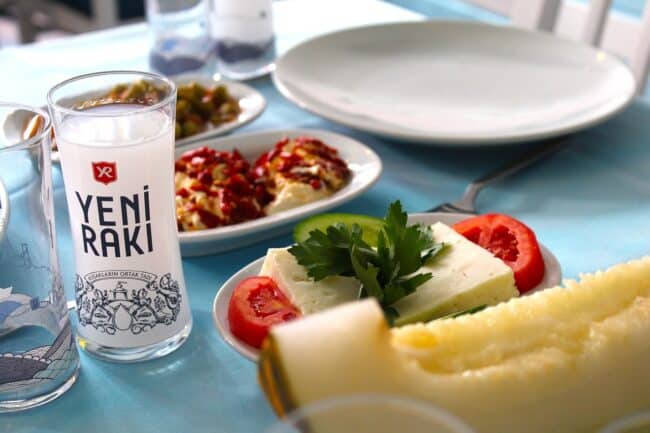
If you ask a Greek person what drink truly represents their land, you might be surprised. The answer usually isn’t “Ouzo,” even though it’s the national drink, but rather Raki (Raki).
This clear, strong, and unpretentious spirit is the backbone of Greek hospitality. It needs no ice, no dilution with water, and certainly no unnecessary introductions. It simply sits on the table, waiting for you to say “Yamas” (Cheers).
So, don’t be surprised when you sit down at a Greek tavern. Even before you order food (or right after you finish), a small carafe filled with a clear liquid will likely land on your table – your entry ticket to local culture and the locals’ way of saying “Welcome.”
While the name “Raki” is automatically associated with Turkey as its national drink, in Greece, and especially in Crete, it has a massive presence. It’s not just another alcohol, but a symbol of hospitality, friendship, and tradition passed down through generations. So, what is the difference between Turkish Raki, Cretan Raki, and Ouzo? All the answers are coming up.
What is Raki anyway? (Hint: It’s not Ouzo)
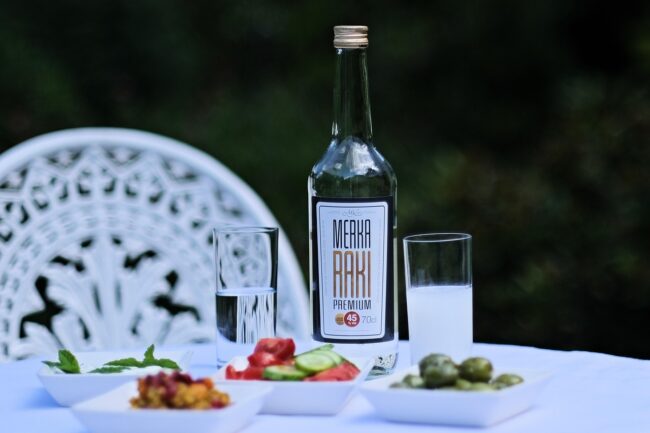
Many confuse Raki with Ouzo, but they are two different worlds:
- Raki brings the flavors of the earth and the vineyard, served chilled or at room temperature (so the grape flavor isn’t lost).
- Ouzo is a “lifestyle” drink that demands ice, changes its color to a mesmerizing white, and is identified more than anything with the eternal Greek summer.
Therefore, in traditional Greek taverns, the choice between them isn’t just a matter of taste, but first and foremost a matter of regional identity.
Raki, sometimes referred to as Tsikoudia or Tsipouro, is a pure grape distillate. It is produced from what remains of the grapes after wine pressing: the skins, seeds, and stalks.
The result is a strong spirit (around 40% alcohol), clear, with a delicate fruity aroma. By the way, only in Crete is the drink called Raki and served without anise (in the rest of Greece, there are versions with and without anise), but we’ll discuss that later.
The Distillation Tradition: From Religious Ceremony to Culinary Celebration
All over Greece, the Raki season begins right after the wine finishes fermenting (in October-November). Like almost everything in Greece, this is a social ritual. Friends and family gather for the “Kazania” celebrations, one of the most authentic and exciting events in Greek culture.
Everyone gathers around the “Kazani” (distillation cauldron), which requires a government permit to operate during this period. They eat roast meat during the hours it takes for the Raki to distill, sing songs, and wait for the first drops of fresh Raki, known as “Protoraki” (Proto means first in Greek).
This specific Raki is exceptionally strong, with a high alcohol percentage that makes it undrinkable (up to 80%), so it is considered the soul of the long distillation process. It is a moment of grace where the farmer’s hard work turns into pure joy.
All that remains is to gently dilute the Raki to lower the alcohol content to a drinkable level (45-50%), smell the fermented grapes, and enjoy every sip.
The Map of Raki: Eastern Connection and Geographic Complexity
As you get closer to the eastern edge of the Greek map and the border with Turkey (Rhodes, Kos, Samos, Symi), the affinity for Turkish Raki-like drinks naturally strengthens. However, the story is more complex than it meets the eye.
Greeks (at least Cretans) swear that the origin of the word “Raki” comes from the ancient Greek word “Rax,” meaning grape. The Turks, on the other hand, claim the source is the word “Araq,” which means “distilled” in Arabic. But that’s obviously not all.
Raki in Turkey is always served with anise and turns white in water, whereas Raki in Greece (at least the Cretan version bearing the name Raki) is never served with anise. Additionally, every region in Greece has its own Raki. Here are a few differences in a nutshell:
Thrace and East Macedonia
In the northeastern region bordering Turkey, the culinary influence is most felt. Here you will find versions of Tsipouro served with anise – very similar to Turkish Raki, unlike the rest of Greece where Raki remains pure.
North-East Aegean Islands
In islands like Lesvos and Chios, physical proximity to Turkey created a very similar drinking culture, so there is a strong preference for anise-based drinks here.
Crete (The Interesting Exception)
Despite the distance from Turkey, the name “Raki” dominates the island. While it is a remnant of the Ottoman era, the taste is distinctly local – completely anise-free, powerful, and pure.
Here they also make Raki from mulberries, called “Mournoraki,” but it is more expensive. Therefore, it is customary to offer tourists Strawberry Raki as a souvenir – regular Raki infused with strawberries and sugar.

Raki in the World
Greek Raki is part of a large family of “pomace” spirits that characterize Europe. Here are some examples:
- Albania: Raki is the national drink, distilled from plums or mulberries. It accompanies Albanians from morning coffee until night and is also called Rakia.
- Cyprus: Zivania is the local equivalent. A powerful spirit served ice-cold alongside salty meze.
- Czech Republic: Slivovitz (plum brandy) is the northern brother of Raki. It is strong, clear, and an integral part of rural tradition, just like Raki in Greece.
Where is it recommended to drink Raki in Greece?
All over Greece and in its nightlife centers, there are places that have made Raki the center of attention:
- Avli (Rethymno, Crete): A restaurant in a Venetian courtyard where Raki is served to the highest standard, pure and chilled.
- Peskesi (Heraklion, Crete): Recommended for its “Rakomelo” (Raki with honey and spices) which receives universal praise.
- To Kafeneio (Athens, Plaka neighborhood): A classic place to experience high-quality Raki in the heart of the picturesque neighborhood.
How to drink Raki correctly?
The strongest and most important rule in Greece: You never drink Raki alone. Raki requires company, good conversation, and a few small plates of meze on the table.
Raki is not a drink for quick “shots” downed in one go, but for small sips that connect people and extend the evening. The next time you are in Greece, look for the clear bottle. It is the shortest way to the locals’ hearts and to an even more successful vacation. Yamas!
Useful links
מתוייג ב:
Food & Drink


![[Advanced Guide] How to Find Discounted Flights by Masking Your Footprints with a VPN](https://yevanist.com/wp-content/uploads/2022/10/בלש-חושב-אחרי-מעקב-על-עקבות.jpg)