

Many know Greece for its turquoise beaches, white villages, and impressive antiquities, but the truth is that to truly know the Greek soul, you have to wait for sunset. Greek nightlife is far beyond a casual outing or a way to pass time; it is a profound cultural phenomenon, an entire world that comes to life just as ordinary tourists retire for the night. The shift in atmosphere is almost immediate: the tempo rises, streets fill with diverse music, and the air fills with the scents of anise, thin smoke, and charcoal grills. In Greece, the night is not the end of the day, but the beginning of a new life.
At the heart of the nocturnal experience stands the elusive and essential Greek concept: “Kefi.” It is hard to translate into a single precise word, but it is a distilled combination of bursting joy of life, passion, total release from daily worries, and absolute enjoyment of the here and now. Kefi is the fuel that keeps tavernas running until the small hours of the morning, the reason spontaneous dancing is such a common sight, and what makes every night out in Greece an emotional and connecting experience, rather than just a social event of drinking and dancing.
It is important to understand that Greece by night is not monolithic, offering much more than the old cliché of plate smashing. The nightlife scene ranges across a fascinating spectrum: on one hand, the glittering international super-clubs of Mykonos and Athens, hosting the world’s biggest DJs and offering unparalleled standards of luxury and design; and on the other, the small neighborhood tavernas where the bouzouki, local wine, and moving sing-alongs still rule.
Types of Entertainment: From Intimate Bouzoukias to Trendy Rooftops
Bouzoukias and Tavernas
A common mistake among tourists arriving in Greece is the confusion between a “Taverna” and a “Bouzoukia.” While many visitors tend to call any place with Greek music a “Taverna,” in Greece, the distinction is clear and important. The traditional taverna is first and foremost a place for food. The music there, if present, is usually acoustic, pleasant, and accompanies the meal.
In contrast, the Bouzoukia – or by its more modern name “Pista” (The Stage) – is a temple of nightlife. It is a nightclub in every sense, where the performance is the main course. In a Bouzoukia, the audience sits around high tables with bottles of whiskey or vodka, and Greece’s biggest singers put on a show that lasts until dawn. It is an intense, loud, and high-energy outing that usually begins only after midnight.
An inseparable part of the Bouzoukia culture is the custom of flower throwing. If in the past plate smashing was the symbol of bursting joy, today flower trays have taken its place. During the performance, flower girls walk between the tables selling trays loaded with flowers, which the audience throws at the singer as a sign of appreciation, love, and sometimes as a status symbol. The more beloved the singer and the more moving the song, the more the stage becomes a colorful and impressive carpet of petals. It is a visual and emotional experience unlike any other in the world.
Greece’s International Club Scene
However, Greek nightlife is not limited to local music. The bar and clubbing scene in the country is world-class. In Athens and the leading islands, you will find mega-clubs hosting the most renowned DJs in the world, with advanced sound and lighting systems. Another unique phenomenon is the “Beach Bars.” These are venues that start in the afternoon with cocktails on a sunbed, and as the sun sets, the volume rises, and the place transforms into a wild dance party on the waterfront.
Rooftops
For those looking for a more relaxed but stylish atmosphere, rooftop bars have become a hot trend, especially in Athens, where you can sip a sophisticated cocktail facing the mesmerizing view of the illuminated Acropolis at night.
The Soundtrack of the Greek Night: From Rough Rebetiko to Glittering Pop
To understand the dynamics of nightlife in Greece, one must know the three musical pillars that move the dance floors. It all starts with Rebetiko, sometimes called “The Greek Blues.” This style was born in the hashish dens of Piraeus and Thessaloniki in the 1920s and 30s—music of refugees and pain sung accompanied by bouzouki and baglamas. Today you will hear it mainly in small, authentic tavernas, in an intimate and unpretentious atmosphere.
From it grew Laïko, the urban folk music that developed from the 1950s onwards. Laïko is the beating heart of the classic Bouzoukia; songs full of emotion about love, betrayal, and longing that bring the audience to their feet for massive sing-alongs.
Finally, one cannot ignore contemporary Greek Pop, the style you will hear in mega-clubs and trendy bars. It is an addictive combination of traditional rhythms and trills with electronic beats and polished Western production, a style representing the new Greece: respecting the past, but celebrating the present with full force.
Nightlife Hubs in Greece
To experience the full power of the Greek night, you need to know where to point your compass. At the top of the list is, of course, Athens, the capital that never rests. Nightlife in Athens is a spectacular mosaic of styles: from the Gazi neighborhood, an industrial area turned mega-club complex around old gas chimneys, through the picturesque and vibrant alleys of Psiri filled with small bars, graffiti, and Ouzo flowing like water, to the prestigious Kolonaki neighborhood, where the Athenian elite gather in stylish “see and be seen” bars. The highlight in recent years is the rooftop bars around Monastiraki Square, offering sophisticated cocktails facing the illuminated Parthenon – a backdrop with no competitors in the world.
If Athens is the queen, Mykonos is the wild, international prince. On the island, sometimes called “The Ibiza of Greece,” a completely different entertainment scene buzzes. Here, the party starts at noon in the famous beach clubs (like Super Paradise or Scorpios), where champagne flows and dancing on tables is routine. As darkness falls, the crowd flocks to the narrow alleys of “Chora” (the Old Town), where crowded and luxurious bars offer an intimate yet intense experience until the small hours.
In contrast to the madness of Mykonos, Santorini offers a more romantic and relaxed alternative. Nightlife there centers around quality wine bars and elegant cocktails in Fira and Oia, with an emphasis on the atmosphere and breathtaking view rather than high volume.
One must not forget Thessaloniki, the second-largest city, holding the unofficial title of “The Balkan Entertainment Capital.” Thanks to its large student population, Thessaloniki offers a young, liberated, and accessible vibe. The historic Ladadika district, once a commercial center, has become a bustling pedestrian area packed with tavernas, bars, and clubs where food and music mix in perfect harmony.
Finally, for the younger crowd (backpackers and students), islands like Ios and Zakynthos remain strongholds of wild parties, with endless bar strips and affordable alcohol prices attracting tourists from all over Europe for a celebration that lasts until sunrise.
Drinking Culture and Night Food
You cannot talk about Greek nightlife without mentioning the fuel that drives it. First and foremost is, of course, Ouzo, the national anise-flavored drink, which is diluted with water and ice in summer and warms the body and heart in winter. But the truth is that in many places, especially in Northern Greece and Crete, the real stars are Tsipouro and Raki. These are strong, clear grape distillates (similar to Italian Grappa), served in small carafes to the table as an integral part of social outings.
Unlike the Western culture of quick “shots,” in Greece, people drink slowly, sip and chat, and always—but always—alongside small meze dishes: olives, feta cheese, pickled octopus, or crisp cucumber, designed to balance the alcohol and whet the appetite. In recent years, the Greek wine industry is also undergoing a huge renaissance, and many bars specialize in local wines from unique varieties like Assyrtiko from Santorini or Agiorgitiko from the Peloponnese.
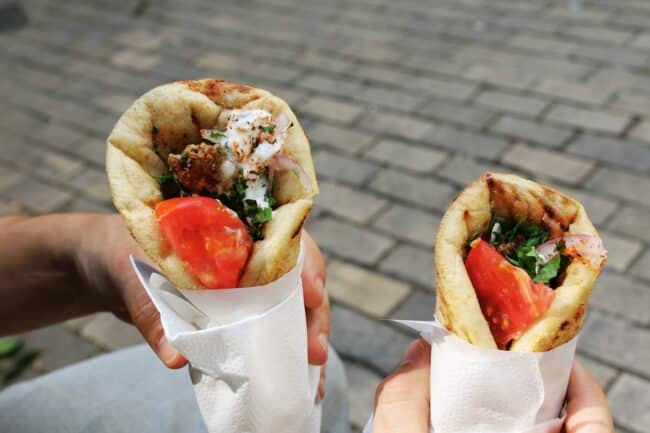
When the music ends and the lights come on, it is time for the final and most important ritual: post-party street food. Just as many cultures have their late-night go-to, Greeks do not go to sleep without “βρώμικο” (Vromiko) – a term of endearment for “dirty food” or fine nocturnal junk food. Outside big clubs and in central squares, you will find “canteens” (food trucks) spreading the intoxicating smell of grilled meat.
The winning dish is undoubtedly the Gyros or Souvlaki, served inside a soft, perfectly greasy Greek pita, loaded with tzatziki, tomatoes, onions, and chips (which go inside the pita!). It is the bite that closes the night, lines the stomach, and leaves a taste for next time.
Smoke, Hookahs and Everything in Between: The Unwritten Rules
Another dominant aspect of Greek nightlife is the smoking culture, which is quite different from what is common in Western Europe. Greece has high smoking rates, and although laws prohibiting indoor smoking exist on paper, enforcement is often lax.
In most tavernas, bars (especially those with semi-open spaces), and even some clubs, ashtrays are a must-have item on the table, and smoke is part of the atmosphere. Alongside cigarettes, Hookah (Shisha) culture flourishes in Greece and is considered an upscale activity. In prestigious clubs and beach bars, you will find elaborate “Hookah menus” with premium tobaccos and service that comes right to your table or sunbed, sometimes at prices rivaling bottle service.
It is important to clarify the subject of cannabis, where many tourists tend to get confused: Greece is flooded with shops selling cannabis products legally, but these are CBD products only (the non-psychoactive substance), sold even in kiosks.
In contrast, cannabis containing THC is illegal, and the Greek police are very strict on the matter. There is no legalization, and foreign medical licenses are generally not valid in Greece. It is highly recommended to avoid unnecessary trouble with local law and settle for Ouzo and the natural intoxicating atmosphere of Greece and its islands.
Tips: How to Party Like a Local?
To avoid awkwardness and get the most out of the Greek night, the first thing to adopt is the local clock. Unlike other countries where bars fill up by 10:00 PM, in Greece, that is the time for a relaxed dinner. In fact, if you arrive at a nightclub or Bouzoukia before midnight, you will likely find the place completely empty. The real “peak” in clubs starts only around 2:00-3:00 AM, and parties usually last until the sun comes up. Therefore, the recommendation is to take your time: a good afternoon nap (siesta) is almost mandatory if you plan to go out, and dinner is an event in itself that can last for hours.
Another critical topic to understand is the reservation culture. In Greece, spontaneity is nice for small tavernas, but in prestigious Bouzoukias and the mega-clubs of Athens and Mykonos – without a reservation, you simply won’t get in (or you will stand in an endless line).
In Bouzoukias, the reservation is usually for a table and requires ordering a bottle of alcohol for every 4-6 guests. If you prefer to just have a drink standing at the bar, it is possible, but the experience is completely different. During peak season, it is recommended to book weeks in advance!
Greeks, and especially Athenians, dress up before going out. While the atmosphere on the islands is looser, in the big clubs in Athens and prestigious places in Mykonos, flip-flops and surf shorts won’t pass selection. The dress code is elegant and meticulous.
In terms of safety, Greece is considered very safe, but in the crowded nightlife areas of Athens (like Gazi and Monastiraki), beware of pickpockets, especially in the late hours when alertness drops. Keep phones and wallets in front pockets or closed bags.
Ultimately, Greece’s nightlife is much more than just a bonus to your beach vacation – it is an authentic glimpse into the beating heart of local culture. Greeks know how to work hard, but they know how to live and celebrate even better.
Whether you find yourself dancing until sunrise at a glittering beach club in Mykonos, surrounded by flower petals in a Bouzoukia in Athens, or simply passing a romantic and calm evening with a glass of wine facing the caldera in Santorini – this nocturnal experience will stay with you long after you return.
The most important recommendation for anyone visiting Greece is simply to surrender to the local “Kefi.” For at least one night – leave the watch aside, leave worries in the hotel room, and let the rhythm, flavors, and people sweep you away. The Greek night is always open, and always ready to welcome you with open arms and a glass of Ouzo. Yamas! (Cheers!).