
The public transportation system in Greece has undergone a significant upgrade over the last two decades, now offering a fascinating blend of modern infrastructure and scenic, historical routes.
While Greece is often identified with island hopping by ferry, getting around mainland Greece is typically done by renting a car or using public transport: the national railway network and the efficient KTEL bus system.
Public transportation in Greece provides a convenient, affordable, and often breathtaking way to discover the north and south of the country. In fact, it is much more than just a means of getting from A to B; it is an integral part of the travel experience itself.
Trains
Traveling by train in Greece combines comfort and safety with reasonable pricing. The Greek railway network spans approximately 2,500 km, covering most of mainland Greece and transporting passengers and cargo along regularly maintained routes. There are three main routes in this network:
- The Athens-Thessaloniki line: Considered the ideal way to get to know mainland Greece. The journey takes about 4.5 hours on the express train (Eter or the “White Train”) and about 6 hours on a regular train. Since frequencies may vary, it is recommended to check the schedule in advance on the official Hellenic Train website. For high-speed trains, booking tickets in advance is highly recommended as seats tend to fill up quickly.
- The Drama to Xanthi line: Widely regarded as one of the most beautiful train routes in Europe. Designed in the 19th century, the line passes through stunning landscapes, following the path of the Nestos River and providing views of golden banks in their spectacular natural setting.
- The Athens to Peloponnese line: This route combines a suburban train ride to Corinth and continues via KTEL buses or the railway’s bus service to various cities, towns, and villages across the peninsula.
Suburban Railway (Proastiakos)
The Greek suburban railway does not only connect major urban centers to their outskirts but also passes through many scenic areas of unique beauty. This is an opportunity to experience landscapes that are often inaccessible except by rail.
The most important suburban line connects Athens International Airport to the city center and the Port of Piraeus.
The suburban railway is more than just a vehicle for sightseeing; it offers significant cultural value. Most of the old stations along the route were built in the late 19th century, blending traditional architecture with opportunities to see local craftsmanship.
Tourist Trains
In addition to the regular high-speed and suburban routes, there are special tourist routes in mainland Greece (steam trains or museum trains) operated upon request. These include:
- Diakopto – Kalavryta (The Odontotos Rack Railway).
- The Pelion Steam Train, which operates mainly on weekends and during the spring and autumn seasons.
- The Nestos Train – This route is considered one of the most beautiful in Europe and is often referred to as the “Amazon of Greece” due to the dense, wild vegetation it traverses.
Buses in Greece
Most regions in Greece are connected by a network of regular intercity bus lines known as KTEL. These buses meet all modern specifications for safe and enjoyable travel, making them the most efficient way to get around Greece.
It is important to note that each region in Greece has its own KTEL company. Therefore, booking tickets should be done on the specific website for that region rather than a single central national site, although the general website is an excellent starting point.
Note: Large cities like Athens sometimes have two different terminals. It is crucial to check which terminal your bus departs from to avoid losing valuable time.
Taxis in Greece
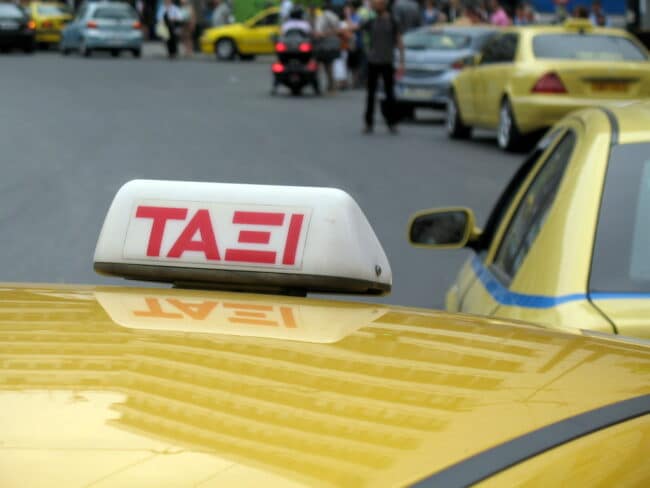
Taxis are an integral part of the urban and tourist fabric in Greece. In major cities, they are easily identified by their uniform colors: yellow in Athens and blue-and-white in Thessaloniki.
Taxis are highly available and can be hailed on the street, found at designated taxi stands (Piatsa) near ports and train stations, or ordered by phone (Radio Taxi) for a small additional fee.
In major cities, trips are metered, though fixed rates often apply for specific routes (such as from Athens International Airport to the city center). In rural areas or small islands, it is common to agree on a fixed price in advance for popular destinations.
Please be aware that day and night tariffs apply, with the double night rate in effect between 00:00 and 05:00.
Ride-Sharing Apps in Greece
Regarding ride-sharing apps, Uber operates in Greece slightly differently than in other countries due to legal regulations. The primary service available through the app is Uber Taxi, which connects you with an official licensed taxi.
In Athens and several major islands (such as Santorini, Mykonos, etc.), you can also occasionally book Uber Van for groups.
However, the dominant app in the local market and the most recommended for travelers is FREENOW (formerly Beat). It allows you to book regular yellow taxis, track the driver’s location, choose specific vehicle types (e.g., an English-speaking driver), and make secure payments through the app, eliminating the need for cash or price negotiations.
Shared Transportation in Greece
Carpooling and hitchhiking are not as common in modern Greek culture as they are in Northern Europe. Hitchhiking is relatively rare and is not recommended as a primary means of transport for comfort and safety reasons.
However, in very small communities or remote islands where public transport is sparse, locals may offer assistance to travelers on the side of the road, but this is not a service to rely on.
For those looking for long-distance ride-sharing, there are dedicated Facebook groups for travelers in Greece, but there is currently no major commercial app like BlaBlaCar operating on a wide national scale.
Electric Scooters and Bikes
For those seeking creative solutions within cities, electric scooter and bike-sharing services are available in the tourist areas of Athens and Thessaloniki. These are excellent for moving between historical sites without waiting for a taxi or a crowded bus.
A few notes regarding Athens: Enforcement of laws regarding riding on sidewalks and helmet use has tightened, so it is important to follow the rules. Additionally, due to the hilly topography of some neighborhoods, scooters and bikes may not always be the ideal solution.
Ferries
For detailed information about ferries in Greece, please click here or use the following search engine to find buses, trains, and ferries for your trip: