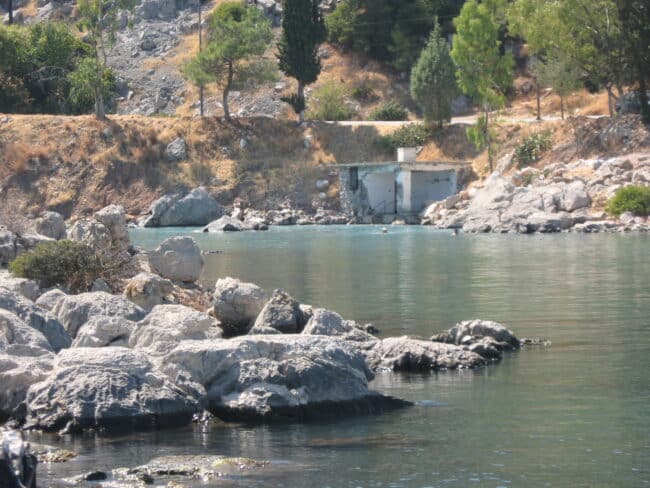

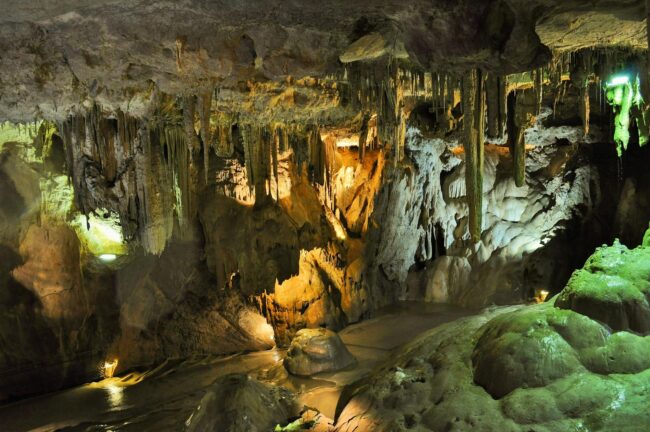
Diros Caves are among the most remarkable natural attractions in the Peloponnese, and one of the most unusual places to visit in Greece. The caves lie on the western coast of the Mani Peninsula, approximately 11 km south of Areopoli, near the village of Pyrgos Dirou, where the dry, rocky landscape of Mani meets the sea. From the outside, there is little to suggest what lies underground: an enormous network of chambers and passages, most of them flooded, filled with stalactites, stalagmites and rock formations that have developed over hundreds of thousands of years.
What makes a visit here particularly special is the boat trip through the cave. Small boats glide slowly between the stalactites, passing through chambers where the water is almost perfectly still and the rock formations are reflected on its surface. This is not a cave you simply walk into, explore for a few minutes and leave. Travelling by boat beneath the ground is central to the experience and makes Diros quite different from most show caves in Greece.
Diros Caves are worth a detour even in a region with plenty of other sights. The combination of an underground boat journey, extraordinary rock formations and the rugged Mani landscape outside creates an experience that is difficult to find elsewhere in Greece. Rather than treating the caves as a standalone attraction, consider making them part of a full day exploring Areopoli, Limeni and the western coast of Mani.
Who Should Visit Diros Caves?
For couples: Diros Caves make an excellent stop on a day out in Mani. The boat ride is peaceful and memorable, and it is easy to combine the visit with Areopoli, Limeni, a meal at a local taverna and a swim at one of the nearby small beaches.
For families: The caves are a particularly appealing attraction because they offer something very different from an archaeological site or a conventional walking trail. Children often enjoy travelling by boat between the stalactites and discovering what feels like a hidden underground world. The cave remains cool even in summer, so bringing a light extra layer is a good idea.
For groups: The caves are a highlight of many organised itineraries around the Mani Peninsula. However, separate admission rules apply to larger groups, and at certain times discounted group tickets are available only for groups of 14 or more people.
For independent travellers: Diros fits naturally into a road trip along western Mani. A rental car is the most convenient way to get there, and you can continue south afterwards to explore small villages, traditional stone towers, secluded swimming coves and the peninsula’s dramatic landscapes.
History and Background
The Diros cave system comprises several caves, including Vlychada, which is open for tourist visits, and Alepotrypa, which is especially important archaeologically. Local people were familiar with the entrance to Vlychada by around 1900, but systematic exploration did not begin until 1949, when Ioannis and Anna Petrocheilou, two of the founders of the Hellenic Speleological Society, began surveying the cave. It opened to visitors in 1967.
Approximately 14.7 km of passages have been mapped so far, and much of the cave system lies underwater. Some stalactites now submerged beneath the surface formed during periods when sea levels were considerably lower. Fossils of animals, including lions, hyenas, panthers and hippopotamuses, have also been discovered in the cave.
The nearby Alepotrypa Cave tells an equally fascinating human story. People used it during the Neolithic period, approximately from the seventh millennium to the end of the fourth millennium BC. Archaeologists have found stone and bone tools, pottery, jewellery, graves and human remains here. Research around Diros Bay suggests that the cave was far more than a temporary shelter: it was an important place for settlement, burial and ritual activity.
Visiting Diros Caves
The experience most closely associated with Diros is the boat trip inside Vlychada Cave. The boat passes through narrow corridors and larger chambers, where stalactites hang from the ceiling, sometimes almost touching the water. Lighting highlights the rock formations, but much of the atmosphere comes from the silence and the reflections on the water.
The cave system is much larger than the section accessible to visitors. The full tourist route is approximately 1.5 km long, including around 1.2 km by boat. However, as of 2026, visits are limited to the shorter lake route and a walking section. Do not rely on older descriptions of the longer boat tour when planning your visit.
Temperatures inside the cave remain almost constant throughout the year. The water temperature is approximately 14°C, while the air generally ranges from 16°C to 19°C. Even on a very hot summer day in Mani, you will notice the change as soon as you enter.
Tickets and Opening Hours
As of 2026, admission to the short route, which includes the lake section followed by the walking exit, costs €12 per adult or €10 for visitors eligible for a reduced ticket. Admission to the walking section only costs €9 per adult or €6 at the reduced rate. Children aged 5 and under enter free of charge.
Tickets are sold at the on-site ticket office upon arrival. At present, advance online booking is not required.
From June to the end of September, the caves are open from 09:00 to 17:00, with the ticket office closing at 16:15. The same hours apply in April, May and October. From November to the end of March, opening hours are 08:30 to 16:30, and the ticket office closes at 15:45. Arriving early in summer can help you avoid the busiest periods and leave time to explore the surrounding area. Always check the official website for any changes before travelling.
Things to Do Nearby
Areopoli is one of the most convenient bases for visiting the caves. About 11 km away, the town has preserved much of Mani’s traditional architecture, including stone houses, narrow lanes, squares and fortified tower houses. In the evening, its centre is one of the area’s most enjoyable places for a meal and a stroll.
Limeni is a short drive from Areopoli and one of the prettiest coastal spots in Mani. Its stone houses stand almost at the water’s edge, the sea is exceptionally clear, and there are several fish restaurants. It makes a particularly good addition to a visit to Diros.
Travelling farther south brings you to Mezapos, Gerolimenas and Vatheia, and eventually to Porto Kagio and Cape Tainaron. The farther south you go, the more remote and rugged Mani becomes, with fewer settlements, more traditional stone towers and steep mountain scenery dropping towards the sea.
Restaurants in the Area
For lunch or dinner, Areopoli and Limeni are generally better choices than the cave complex itself. Areopoli offers a wider selection of tavernas and local restaurants, while Limeni is particularly appealing if you would like fresh fish or seafood with a view of the water.
In Mani, look out for regional specialities such as syglino, the local smoked pork, sausages flavoured with orange, wild greens, local cheeses and dishes prepared with olive oil from Laconia. This is an area where it is worth seeking out tavernas specialising in traditional local cooking rather than international menus.
Where to Stay
Areopoli is generally the most convenient place to stay. It has a good selection of hotels and restaurants and is close to both the caves and the roads leading to other parts of Mani.
- Trapela Areopolis, Boutique Hotel is a traditional stone hotel in central Areopoli, especially convenient if you would like to walk to restaurants and explore the town’s lanes in the evening.
- Areos Polis Boutique Hotel is also in the heart of Areopoli and is a good choice for travellers who want a central base for exploring a different part of Mani each day.
- Mani Hotel is a family-run hotel near the centre of Areopoli, with convenient vehicle access and parking. It works particularly well as a base for day trips around the region.
- Ktima Karageorgou, in the Areopoli area, combines traditional stone architecture with a quieter, more rural atmosphere.
- Limeni Village is an appealing option if you prefer to stay by the sea in Limeni and reach Diros by a short drive.
- Mavromichalai occupies a historic stone building right on the waterfront in Limeni. It is particularly attractive for couples and travellers looking for accommodation with a strong sense of place.
Getting There
Diros Caves are in the southern Peloponnese, and most visitors arrive by car. From Areopoli, the distance is approximately 11 km and the drive takes around 15 minutes.
From the Sparta area, drive south via Gytheio to Areopoli, then follow the road towards Pyrgos Dirou and the caves. From Kalamata, head south along the coast via Oitylo. These are also the two main approaches recommended by the caves’ official website.
Allow approximately 1.5 to 2 hours for the drive from Kalamata, depending on traffic and stops along the way. From Athens, the journey takes several hours, so Diros is much better suited to a two- or three-day stay in Mani than to a standalone day trip from the Greek capital.
If you are touring Mani, public transport is generally not the most practical way to reach the caves. The region is best explored by car, with villages, beaches and viewpoints spread along winding mountain roads. Driving also makes it easy to visit the caves, Areopoli, Limeni and other nearby villages on the same day.
מתוייג ב:
Attractions | Nature | Rustic